If a repossession letter has landed on your mat, the first thing to know is this: a letter is not an eviction. There is almost always more time and more room to act than it feels like in the moment. This guide walks through what genuinely happens at each stage in England and Wales, and what you can still do at each one.
A lender can only repossess your home if a court gives permission, so you nearly always have more time than the letter suggests. What most often stops it: answering your lender early, attending the hearing with a realistic plan to pay, getting free debt advice, or selling the home yourself before the lender takes possession.
This is general information, not legal advice, and it covers England and Wales only (Scotland and Northern Ireland follow different repossession procedures). Every case is different, and a solicitor or a free debt charity like StepChange or National Debtline can advise on your specific situation. We buy houses for cash; we do not provide financial, legal or tax advice.
The stages, in order
Repossession in England and Wales is a court process, not something a lender can do unilaterally. Here is the sequence most cases follow, as set out in gov.uk's guidance on repossession.
-
1
Missed payments and contact from your lender
For regulated mortgages, the FCA's mortgage rules (MCOB 13) say a lender must not repossess unless other reasonable attempts to resolve the arrears have failed. That usually means offers such as payment plans, a payment holiday or extending the term. Answering their calls, even when it feels easier not to, keeps every option on the table.
-
2
The Pre-Action Protocol
Before going to court, your lender must follow the Pre-Action Protocol for Mortgage Arrears, which requires them to have genuinely considered alternatives with you. The gov.uk repossession guide lists what a lender must do first, including telling you how much you owe, considering a request to change how you pay, and giving 15 days' written warning before starting court action. If you think a step was skipped, a free adviser can check.
-
3
Court claim and a possession hearing
The lender applies to the County Court for a possession order and you receive paperwork with a hearing date. Attending matters: gov.uk says that if you do not attend, the judge is likely to give your lender the right to evict you. If you do attend, the judge can adjourn the hearing, set the case aside or make an order, and proof of your finances or of a sale in progress puts you in a stronger position.
-
4
The possession order
An outright order gives the lender the right to your home on the date in the order, usually 28 days after the hearing. A suspended order lets you stay as long as you keep to the payments set out in it. The gov.uk guide to repossession orders explains each type, and the table below summarises them.
-
5
Warrant of possession and eviction
If you have not left by the date in an outright order, or you miss payments under a suspended order, the lender can ask the court to evict you, and county court bailiffs carry out the eviction on a set date. Even at this stage, options exist, including selling before the point of no return, right up until possession actually changes hands.
- 1Missed payments
- 2Pre-Action Protocol
- 3Court hearing
- 4Possession order
- 5Eviction date
What the judge can decide
| Outcome | What it means | What happens next |
|---|---|---|
| Adjourned | The hearing is delayed | More time to arrange payments or a sale |
| Set aside | No order is made and the hearing ends | You keep your home for now |
| Outright possession order | The lender gets the right to the home on the date given, usually 28 days after the hearing | If you have not left by then, the lender can ask the court to evict you |
| Suspended possession order | You can stay if you keep to the payments in the order | If you miss payments, the lender can ask the court to evict you |
Source: gov.uk, repossession orders.
Have a court hearing date? Talk to us today
We can agree a price within 24 hours and, where it helps, attend the hearing with you with proof of funds so the court can see a genuine sale is underway.
See how we can helpWhat actually stops repossession
- Engaging early. Lenders must consider a request to change how you pay and respond to any offer you make, so every option starts with getting in touch. Ignoring the letters does not pause the process.
- A realistic repayment plan. If you can show the court a genuine, affordable plan to clear the arrears, the judge has real grounds to adjourn or suspend rather than order eviction.
- Independent debt advice. Free, impartial and can change the shape of a case: StepChange and National Debtline are both genuinely free. If mortgage arrears sit alongside other unaffordable debt repayments, the two often need tackling together, and if a separation is behind the missed payments, our guide to selling a house during a divorce covers joint mortgages.
- Selling before the point of no return. A sale agreed and completed before the lender actually takes possession stops the process entirely, and unlike a repossession sale at auction, you keep whatever equity is left after the mortgage is cleared.
More ways to buy time
- Ask the court to suspend a warrant. Citizens Advice explains you can ask the court to suspend a possession order or warrant, which lets you stay as long as you keep to the payments, or to allow time to sell the property yourself. This is done with court form N244.
- Get free legal help at the hearing. Gov.uk says the Housing Loss Prevention Advice Service can give free advice and representation on the day of your hearing if you have received written notice to leave.
- Use Breathing Space. StepChange describes the Breathing Space scheme as short-term protection, for up to 60 days, while you get debt advice and work out a solution. It is arranged through a debt adviser.
- Ask about the Mortgage Charter. National Debtline notes that, since 26 June 2023, you should not be forced to leave your home within 12 months of your first missed payment unless you agree or there are exceptional circumstances, if your lender has signed up.
Why selling beats letting repossession complete
Once a lender repossesses, the sale is on the lender's timetable, not yours. Three things are worth knowing:
- A shortfall can still be yours to pay. National Debtline explains that repossession could mean there is not enough from the sale to pay what you owe, and the lender can ask you to pay the difference, known as a mortgage shortfall. Gov.uk also notes a lender may still claim money you owe after repossession.
- Selling yourself keeps control with you. Even close to the deadline, you keep control of the price and the process, and any equity above the mortgage balance is yours.
- A sale in progress helps at the hearing. Gov.uk lists a letter from an estate agent as evidence you can bring to a hearing if you are trying to sell your home to pay off the mortgage.
A worked example
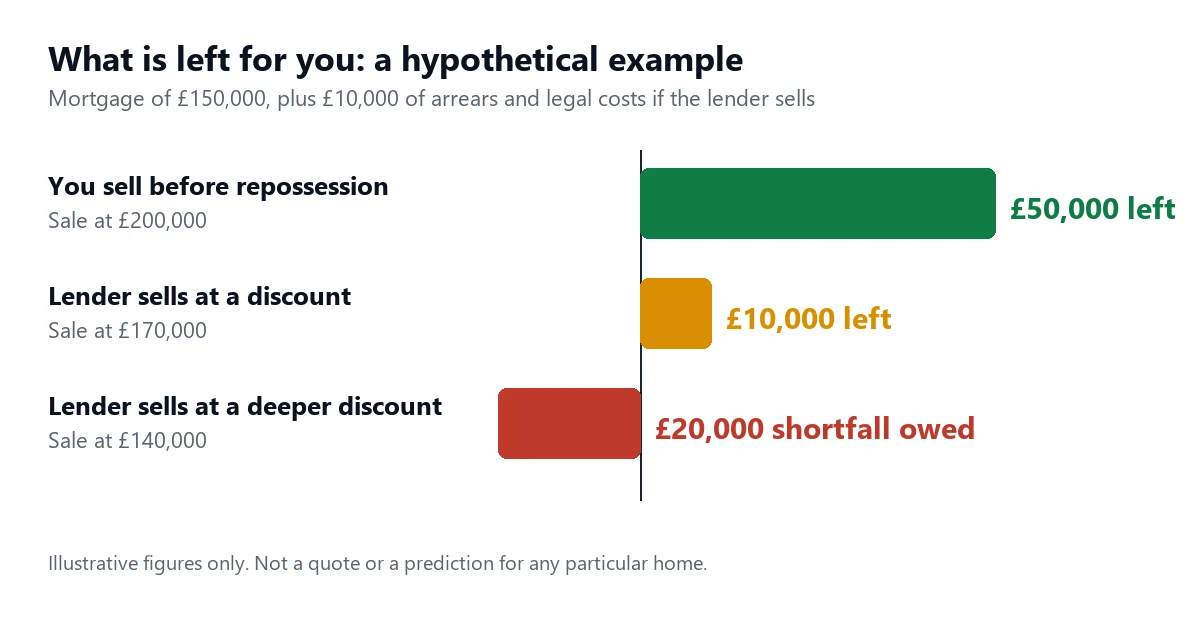
These figures are hypothetical, chosen only to show how the maths works. They are not a quote or a prediction for any particular home.
| Scenario | Sale price | Mortgage and lender costs | Result |
|---|---|---|---|
| You sell before repossession | £200,000 | £150,000 | £50,000 left for you |
| Lender sells at a discount | £170,000 | £160,000 | £10,000 left for you |
| Lender sells at a deeper discount | £140,000 | £160,000 | £20,000 shortfall still owed |
Assumes a £150,000 mortgage, plus £10,000 of arrears and legal costs when the lender sells.
A real case from June 2026
In June 2026 we bought a 2 bed semi-detached house in Wolverhampton (WV10) from a seller whose eviction date was already set by the time they got in touch. That date fell on the day of an emergency possession hearing. The whole sequence took place in June 2026, and the seller has agreed to us sharing it:
- Price agreed within 24 hours of the seller contacting us.
- We attended the emergency possession hearing on the day of the scheduled eviction, alongside the seller and with proof of funds, so the judge could see a genuine sale was underway.
- Contracts were exchanged and the sale completed within 7 days of the start.
- The case was withdrawn once the sale was under way.
Every case is different, and not every sale can move this fast. This one worked because the seller acted before the eviction date and the sale was already progressing when the court looked at it. See it alongside our other purchases on the case studies page. Shared with the seller's consent.
Common questions about repossession
How long does repossession take in England and Wales?
There is no fixed timescale. Lenders must follow the Pre-Action Protocol before going to court, timings vary by court and lender, and a possession order does not mean immediate eviction: an outright order usually gives a date around 28 days after the hearing. Every case moves at a different pace, and engaging early gives you the most room.
Can I sell my house after a possession order has been made?
Often, yes. Citizens Advice says that if your lender has a warrant of possession, you can ask the court to suspend it to get time to sell the property yourself. Selling before the lender takes possession keeps the price and timing in your hands, and any equity above the mortgage balance is yours.
Will repossession affect my future mortgage applications?
If your home is repossessed, gov.uk says you must tell any new mortgage lender, which could make getting another mortgage hard. Acting before the process escalates is one of the reasons people choose to sell early.
Does this process apply in Scotland or Northern Ireland?
No. This guide covers England and Wales, where repossession runs through the County Court under the process above. Scotland uses a separate system centred on the Sheriff Court, and Northern Ireland has its own court procedure. If you are in Scotland or Northern Ireland, MoneyHelper can point you to the right local process.