The house is often the biggest asset in a divorce, and the biggest source of disagreement about what happens next. If you want to sell a house while divorce proceedings are still going through, the practical questions come before the legal ones. Can you sell at all? Does your ex-partner have to agree? What happens to the tax bill? This guide sets out what gov.uk and HMRC actually say, and where the rules changed.
You can sell the family home during a divorce, but if you own it jointly you both need to agree, or a court has to decide. An informal agreement is not enforceable until it is made into a consent order, which costs £62. If you cannot agree, either of you can ask the court for a financial order instead, which costs £321. Since 6 April 2023, separating couples have up to three years to transfer assets between themselves without triggering Capital Gains Tax, or longer if it is part of a formal agreement.
This is general information, not legal advice, and it covers England and Wales. Gov.uk says the process is different in Scotland and Northern Ireland. Every situation is different, so speak to a solicitor about yours. We buy houses for cash; we do not provide financial, legal or tax advice.
Some terms, in plain English. A consent order is a court-approved document that makes an agreement about money and property legally binding. A financial order is what you apply for if you cannot agree, so a judge decides instead. The conditional order (previously called a decree nisi) and the final order (previously a decree absolute) are the two stages of the divorce itself. Home rights are rights a non-owning spouse can register to help protect their position in the property.
Do joint owners both have to agree to sell?
Yes, but if you own the property jointly, you both need to agree to a sale, or a court has to decide. Gov.uk treats the house as one part of a wider financial agreement that also covers pensions, savings and investments, rather than something to settle on its own.
Where the property is only in one partner's name, the position is more complicated. A non-owning spouse can still have a financial interest in the home, or can register home rights, covered below.
If there is still a mortgage on the property, selling it works the same way it would outside a divorce. Your lender provides a redemption figure, and the mortgage is repaid out of the sale proceeds at completion, arranged by your solicitor as a normal part of the conveyancing. The one exception is a shortfall sale: if the sale price would not cover what you owe, you also need your lender's consent, since they are being asked to accept a loss.
Making an agreement legally binding: the consent order
Say you and your ex-partner agree how to divide your money and property. Gov.uk says you still need to apply for a consent order to make that agreement legally binding. Without one, a court cannot enforce it later if something goes wrong.
- Cost: the court fee is £62.
- When: the court cannot approve a consent order before the conditional order. It is usually simpler to apply before the final order too, since applying after that can have financial consequences, particularly for pensions.
- Process: you draft and sign the order, fill in a statement of information form, and send it with the fee. There is usually no hearing. A judge approves it if they think it is fair, or asks you to change it if not.
If you cannot agree: the court decides
If you and your ex-partner cannot agree, either of you can ask the court to make a financial order instead, sometimes called the contested or ancillary relief route. Gov.uk sets out the process:
| Route | Fee | What happens |
|---|---|---|
| Consent order (you agree) | £62 | Court approves your agreement, usually with no hearing |
| Financial order (you cannot agree) | £321 | A judge decides, after a first appointment, a financial dispute resolution appointment, and a final hearing if still needed |
Sources: gov.uk, if you agree and gov.uk, get the court to decide.
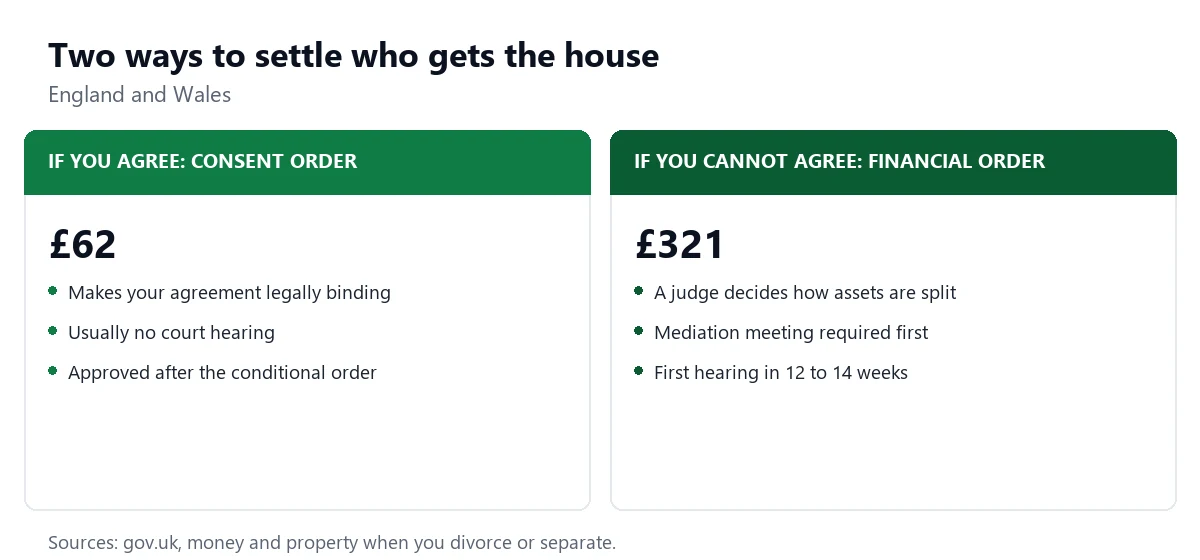
You must usually attend a meeting about mediation before applying for a financial order, except in specific cases such as domestic abuse. The first appointment is usually 12 to 14 weeks after you apply. After that, there can be a financial dispute resolution appointment, then a final hearing if one is still needed. The judge weighs up several factors: how long you were married, your age, your ability to earn, your property and money, your living expenses, and who cared for the family. The reason for the divorce is not one of them.
Can one of you stop a sale? Home rights
Not being on the title does not leave you with no protection. Gov.uk explains that you can register "home rights" with HM Land Registry, which can help stop your partner selling the home without you knowing. Your rights are different if you own the property jointly. You cannot apply for home rights if your partner owns the property with someone else, unless they would get all the proceeds if it were sold.
Home rights are not indefinite. Gov.uk says you can usually only live in the property until the divorce is finalised and a court settlement agreed, unless a court makes a "continuation order" allowing you to stay longer.
Capital gains tax on the family home: what changed in 2023
Most people selling the only home they have lived in will not owe Capital Gains Tax on the sale itself, because of Private Residence Relief. Where tax can arise is on a share of the property transferred between spouses, and the rules for that changed in April 2023.
- Before 6 April 2023: "no gain, no loss" transfers between separating spouses were only available for the remainder of the tax year of separation, a very tight window.
- From 6 April 2023: HMRC's policy paper (published 15 March 2023) gives separating spouses and civil partners longer. They now have up to three years after the year they stop living together to make no gain, no loss transfers between themselves.
- Formal agreements: if the transfer is part of a formal divorce agreement, there is no time limit at all.
There is a catch for the receiving spouse. HMRC says they are treated as acquiring the asset at the transferring spouse's original base cost, so they can face a bigger gain if they sell later. The same 2023 measure also gives a spouse who keeps a financial interest in the former family home the option to claim Private Residence Relief when it is eventually sold. Our guide to capital gains tax on inherited property explains how the gain calculation itself works, though the date-of-death rule there does not apply to a home bought together.
Can you sell before the divorce is final?
Often, yes, in principle. Being able to sell is a separate question from making your financial agreement legally binding, and from actually completing a sale. As our own guide to selling during a divorce puts it: "Often, yes. We can agree a price and work alongside your solicitors while the consent order is being finalised, so the sale is ready to complete as soon as the order allows. Talk to us early and we will fit around your legal timeline rather than the other way round."
Hypothetical example, to show how the timing can work: a couple jointly own their home and agree they both want to sell rather than either of them keeping it. Their solicitors are still drafting the consent order when they accept a cash offer. Because accepting an offer and completing a sale are separate from making the financial agreement legally binding, the sale can proceed alongside the paperwork, with completion timed for once the order is approved. This is illustrative only; every case depends on your own solicitor's advice.
Selling the family home?
Tell us about it and we will give you a fixed cash offer that fits around your solicitors, with our conveyancing fees paid.
Get my cash offerSelling to a cash buyer during a divorce
As our page on selling your house during a divorce puts it: "if you are joint owners we need both of you to agree to the sale and instruct solicitors. A fixed written cash offer often makes that conversation easier than an open-ended estate agent valuation, because there is a single number to agree on rather than a guessing game about what the market might pay."
Being honest about the trade-off: our offers, like most cash buyers', are usually below what an open-market sale might achieve. That suits situations where certainty and a timeline that fits around the legal process matter more than the highest possible price. You can read more about how we source and review our guides in our editorial policy.
FAQs: selling a house during a divorce
Can my husband or wife force me to sell the house during a divorce?
Not on their own if you are joint owners; you both need to agree, or a court has to decide. If you do not own the property, gov.uk explains that you can register "home rights" with HM Land Registry, which can help stop your partner selling the home without you knowing. Rights differ depending on how the property is owned, so check your own position.
Do I have to sell my house in a divorce?
Not necessarily. Selling is one option when you divide pensions, property, savings and investments, but you and your ex-partner could also agree that one of you keeps the home, often alongside other assets, or that a share of it transfers later. Keeping the home usually means a transfer of equity, where the departing spouse's share moves into the other's sole name. If a lender needs to reassess affordability, the remaining spouse may also need to remortgage in their own name. What happens depends on what you agree, or what a court decides if you cannot.
Can I sell the house before the divorce is final?
Often, yes, in principle, though completion usually needs to fit around the legal timeline. Being able to sell the house is a separate step from making the financial agreement legally binding. If you are working with us, we can often agree a price and work alongside your solicitors while the consent order is being finalised, so the sale is ready to complete as soon as the order allows.
How long do you have to sell the house after divorce?
There is no fixed deadline. Gov.uk does not set a time limit for selling the family home after a divorce; it depends on what you and your ex-partner agree, or what a court orders if you cannot. Some couples sell quickly to divide the proceeds, others agree that one of you stays for a period first. If you register home rights, gov.uk says you can generally only remain in the property until the divorce is finalised and a settlement agreed, unless a court makes a continuation order.
How much does it cost to make a financial agreement legally binding?
If you and your ex-partner agree, applying for a consent order costs £62, according to gov.uk. If you cannot agree and a court has to decide instead, applying for a financial order costs £321.
Will I have to pay capital gains tax on the house?
Often not, if it is the only home you have lived in, because of Private Residence Relief. Where tax could apply is on transfers of a share between spouses. Since 6 April 2023, HMRC gives separating couples up to three years after the year they stop living together to transfer assets between themselves without triggering a gain, or unlimited time if the transfer is part of a formal divorce agreement, according to HMRC's policy paper.
Does this apply in Scotland or Northern Ireland?
No. This guide covers England and Wales. Gov.uk says the divorce process, the consent order and financial order routes, and this guidance on the family home, work differently in Scotland and Northern Ireland.
What to remember
- You can sell during a divorce, but joint owners need to agree, or a court has to decide.
- A consent order makes an agreement legally binding for £62. A financial order, if you cannot agree, costs £321.
- A non-owning spouse can register home rights to help protect their position, though these rights are not indefinite.
- Since 6 April 2023, separating couples get up to three years, or longer for a formal agreement, to transfer assets without triggering Capital Gains Tax.
- Speak to a solicitor about your own situation. If you would like a cash offer, tell us about the property and we will give you an honest figure and timeline.