If you have inherited a house and are thinking of selling it, you may have been warned that capital gains tax (CGT) could apply to it. It might, but it can be small or nil, and it is worked out from a figure many people are never told about. That figure is the value of the property on the date of the death. This guide covers UK capital gains tax (CGT), the rates and deadline as they stand in September 2026, and a worked example.
You do not pay capital gains tax when you inherit a property. You pay it only if you sell for more than it was worth on the date of the death, and only on the gain above your £3,000 tax-free allowance. If tax is due on UK residential property, you must report and pay it within 60 days of completion. Executors report within 60 days and pay when HMRC contacts them.
This is general information, not tax advice, and it covers UK capital gains tax. Rules for inheriting property differ in Scotland. Every situation is different, so check your own position with an accountant or HMRC. We buy houses for cash; we do not provide financial, legal or tax advice.
Do you pay tax when you inherit a house or other property?
No. There is no capital gains tax on inheritance itself. Gov.uk confirms you do not pay Stamp Duty, Income Tax or Capital Gains Tax immediately when you inherit a property. CGT on an inherited house or other property can arise later, when you sell it.
Inheritance Tax is a separate tax. The executor (the personal representative) normally pays any Inheritance Tax due before you receive the inheritance, and the Inheritance Tax threshold is £325,000, according to gov.uk. That is dealt with by the estate, not through the capital gains rules below.
Capital gains tax applies to the profit when you sell. Per gov.uk, you do not pay it when you sell your own main home, but you do pay it on a profit from selling a property that is not your main home.
How capital gains on inherited property are worked out
The gain is the sale price, minus the value of the property on the date of the death, minus your allowable costs. Here are the steps:
- Find the value on the date of death. HMRC treats a person who inherits as acquiring the property on the date of death at its market value then (HMRC helpsheet HS282). Gov.uk advises using market value where you inherited the property and do not know the Inheritance Tax value. Keep the probate valuation.
- Take the sale price. That is what you actually receive on completion.
- Deduct allowable costs. The guidance lists estate agents' and solicitors' fees and the cost of improvement works such as an extension. Normal maintenance such as decorating does not count.
- Work out your share. If the property is jointly owned, you work out the gain on your own share.
- Deduct the tax-free allowance. You only pay tax on gains above the annual allowance, which is £3,000 for an individual.
Rates and the tax-free allowance
| Who | Rate or allowance |
|---|---|
| Higher or additional rate taxpayer | 24% for the 2026 to 2027 tax year |
| Basic rate taxpayer | 18% on the part of the gain that falls within the basic rate band, 24% on any part above it |
| Executors (personal representatives) and trustees | 24% on all assets for disposals on or after 30 October 2024 |
| Tax-free allowance | £3,000 for individuals, £1,500 for trusts |
Sources: gov.uk, CGT rates, gov.uk, allowances and HMRC HS282.
There is a simple method to see which rate applies to you. First, work out your taxable income: your income minus your Personal Allowance and any other reliefs. Second, deduct the £3,000 allowance from your total taxable gains. Third, add the result to your taxable income. The part that falls within the basic rate band (£37,700 for 2026 to 2027) is taxed at 18%, and any part above it at 24%.
When to report and pay
For UK residential property you must report and pay any capital gains tax due within 60 days of completing the sale, according to gov.uk. Interest and a penalty can apply if you are late.
- 1Date of death (value fixed)
- 2Probate granted
- 3Sale agreed
- 4Completion (day 0)
- 5Day 60: report and pay
You report through a Capital Gains Tax on UK property account online. You will need the address, the date you got the property, the exchange and completion dates, the value when you got it and when you sold it, your costs and any reliefs, as gov.uk sets out. If you are already registered for Self Assessment, you also include the sale in your tax return.
Who pays: you or the executor?
It depends on who owns the property when it is sold. While the estate still owns it, the personal representatives deal with the tax. Once it has been transferred to you, the tax on a later sale is yours.
- Executors get their own allowance. HMRC helpsheet HS282 says personal representatives can use a full annual exempt amount for the period from the date of death to the following 5 April, and for the 2 tax years after the year of death. There is one amount per year, and none for gains in later years.
- Executors pay 24%. The same helpsheet gives the rate for personal representatives as 24% on all assets for disposals on or after 30 October 2024.
- You cannot claim the executors' costs of establishing title. A beneficiary who later sells cannot claim those expenses or the executors' unused losses.
- The estate reports its sale within 60 days too. HMRC helpsheet HS282 says personal representatives who sell UK property must tell HMRC within 60 days of completion, but they do not pay at the same time as the online return: HMRC contacts them with the amount due and how to pay. Gov.uk also says to include the sale when reporting the estate.
Timing can therefore matter: whether the estate sells, or a beneficiary sells after receiving the property, can change which allowance and which rate apply. An accountant can tell you what applies in your case.
A worked example
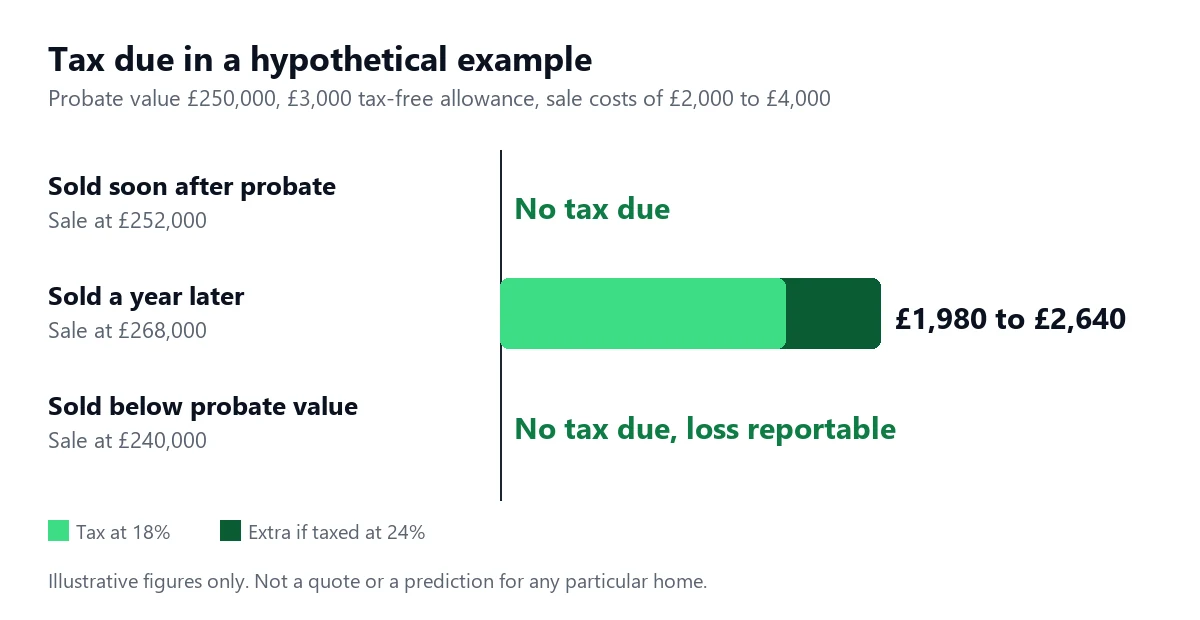
These figures are hypothetical, chosen only to show how the maths works. They are not a quote or a prediction for any particular property. They assume a probate value of £250,000, that you own the property personally (not the executors), the full £3,000 allowance and no other gains in the year. If the estate sells, executors pay a flat 24%.
| Scenario | Sale price | Costs | Gain | After £3,000 allowance | Tax at 18% to 24% |
|---|---|---|---|---|---|
| Sold soon after probate | £252,000 | £2,000 | £0 | £0 | £0 |
| Sold a year later | £268,000 | £4,000 | £14,000 | £11,000 | £1,980 to £2,640 |
| Sold below probate value | £240,000 | £3,000 | No gain (a £13,000 loss) | £0 | £0 |
Gain = sale price minus £250,000 probate value minus costs. Tax is shown at both rates for comparison, because the rate depends on your income.
Two siblings inherit a house and sell it
Again, these figures are hypothetical. Two siblings inherit a house that was valued at £250,000 on the date of death. It passes to them in equal shares, and six months later they sell it together for £262,000, with £3,000 of allowable costs between them.
- The total gain: £262,000 minus £250,000 minus £3,000 is £9,000.
- Each sibling's share: £4,500.
- After each sibling's own £3,000 allowance: £1,500 each.
- Tax on that £1,500: £270 each at 18%, or £360 each at 24%. That is £540 to £720 in total.
This assumes the house has been transferred to them and they sell it themselves, that neither has other gains that year, and that each reports their own share within 60 days of completion. If the executors sold the house instead, the estate's allowance and 24% rate would apply, as explained above. The point of the scenario is simple: because the gain is measured from the date-of-death value, a short delay before the sale did not create a large tax bill, and two allowances covered a good part of the gain.
The executors sell the house before it is transferred
Now take the same hypothetical house, valued at £250,000 on the date of death. This time the executors sell it before it is transferred to anyone, for £262,000, with £3,000 of costs, in the tax year of the death or one of the next two. The gain is again £9,000, but the tax is worked out differently.
- One allowance, not two: the estate has a single £3,000 annual exempt amount, so £6,000 is taxable, not £1,500 each for two people.
- A flat rate: executors pay 24%, so the tax is £1,440.
- Timing: the sale must fall in the tax year of the death or one of the next two tax years for the estate's allowance to be available, as HMRC helpsheet HS282 explains. The helpsheet also says some of the executors' costs of establishing title may be allowed against the gain, which this example ignores.
Compare that with the siblings' £540 to £720 above. The property, the sale price and the gain are the same. What changed is who owns the house when it is sold: two individuals with two allowances and possibly the 18% rate, or the estate with one allowance and a flat 24%. The siblings' lower figure also assumes their gains sit inside the basic rate band for the 18% rate to apply. That is why it is worth asking an accountant about the order of events before you agree a sale date. Reporting works the same way in both cases: within 60 days of completion.
Ways the tax can be reduced or avoided
- Use the allowance. The first £3,000 of gains in a tax year is tax-free for an individual.
- Sell soon after probate. Because the starting value is the date-of-death value, the gain from a quick sale can be small, as the first row of the example shows. This depends on how the market moves between the date of death and the sale.
- Deduct your costs. Estate agents' and solicitors' fees and improvement works reduce the gain.
- Report a loss. If you sell for less than the starting value, the gov.uk losses guidance says a loss can be claimed up to 4 years after the end of the tax year of the sale, with restrictions for sales to family and other connected people.
- Main home relief. Private Residence Relief can apply if the property becomes your main home. The last 9 months of ownership always qualify if it was your main home at some point. If inheriting means you own two properties, you must tell HMRC within 2 years which is your main home, according to gov.uk.
- Share between owners. Each joint owner works out their own share, and each has their own £3,000 allowance.
Beyond the basics, tax planning gets complicated quickly. Speak to an accountant rather than relying on a general guide. If you have let the property out since inheriting it, our guide for landlords covers selling a tenanted or ex-rental property. If the estate also owes mortgage arrears, see how to stop repossession in England and Wales. You can see how we source and review our guides in our editorial policy.
Selling quickly and capital gains tax
A quick sale is often the simplest route for tax, because the gain can be small and the deadline is easy to manage. How quickly you can sell also depends on how long probate takes. If you are ready to sell, our guide to selling an inherited property explains how we buy. Our published probate purchases show realistic timescales. A Coseley home took 28 days start to completion and a Broseley bungalow 56 days. A Walsall property spent around three months waiting on the Grant of Probate, and our offer was held at the agreed price throughout. You can read them among our recent probate purchases.
One point to weigh honestly: a cash sale price is usually lower than what an open-market sale might achieve, so compare what you would keep after costs and tax, not just the tax figure. The right choice depends on how fast you need to sell and what the property needs.
Inherited a property you want to sell?
Tell us about it and we will give you an honest cash offer and a realistic timeline, with solicitor fees paid.
Get my cash offerFAQs: selling an inherited house and tax
Is an inherited property taxable?
Not when you inherit it. According to gov.uk, you do not pay Stamp Duty, Income Tax or Capital Gains Tax immediately. Capital gains tax can apply when you sell for more than the value on the date of the death, and Income Tax can apply to any rent you earn if you let the property out.
What is the difference between inheritance tax and capital gains tax?
Inheritance Tax is normally paid by the executor from the estate before you inherit, with a threshold of £325,000 according to gov.uk. Capital gains tax is a separate tax on the profit when a property is sold. According to gov.uk, the Inheritance Tax value is the starting point for the capital gains calculation where it is known, and market value is used where it is not.
Do I pay capital gains tax if I sell an inherited house straight away?
Possibly little or none. The gain is measured from the value on the date of the death, so a sale soon after probate at a similar price can produce a small gain or none, and the first £3,000 of your gains in a tax year is tax-free. Allowable costs reduce the gain further.
Do I pay tax if I sell for less than the probate value?
There may be no gain to tax. Losses can be reported to HMRC to reduce your taxable gains, and you can claim up to 4 years after the end of the tax year of the sale. Losses on sales to family or other connected people are restricted, and the guidance says to use market value where a property is sold for less than it was worth to help the buyer, so check your position with an accountant.
What if the property is left to several people?
For jointly owned property, you work out the gain on your own share and report your own gain or loss, according to gov.uk. The £3,000 tax-free allowance is per individual, so each person deals with their own share.
Do I need to report the sale if I owe no tax?
The 60-day report is for tax that is due. If your total taxable gains are under the tax-free allowance you do not have to pay, and UK residents do not need to report online. If you are registered for Self Assessment, you must report gains in your tax return where the total you sold assets for was more than £50,000, according to gov.uk. Non-residents must tell HMRC about UK property sales even if no tax is due.
Does this apply in Scotland?
Capital gains tax is a UK tax, but according to gov.uk the rules for inheriting property are different in Scotland, so check Scottish guidance for the probate side.
What to remember
- You do not pay capital gains tax when you inherit a property. You pay it on a gain when you sell.
- The gain is measured from the value on the date of death, minus allowable costs, so keep the probate valuation and your receipts.
- The first £3,000 of gains in a tax year is tax-free. Above that, individuals pay 18% or 24% depending on income, and executors pay 24%.
- If tax is due on UK residential property, report and pay within 60 days of completion. Executors report within 60 days and pay when HMRC contacts them.
- Check your own position with an accountant. If you would like a cash offer on an inherited property, tell us about it and we will give you an honest figure and timeline.
For the full picture on who can sell, when, and how, see our guide to selling a house in probate.