If you are waiting on probate, you are probably waiting for something specific: a house that cannot be sold, a bank account that cannot be touched, or a beneficiary who keeps asking when it will be over. The answers online vary widely, and the official guidance and the official statistics do not quite say the same thing. This guide sets out the published figures, what makes the wait vary, and what it means if a property is involved.
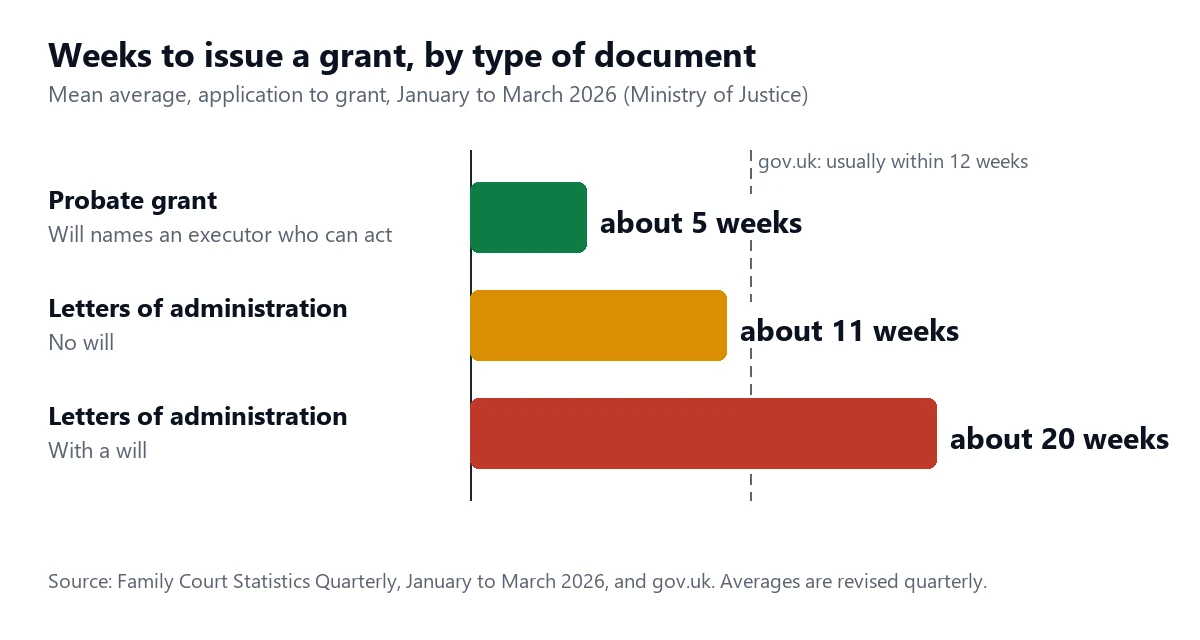
Ministry of Justice figures show probate grants took about 5 weeks on average to be issued after the application in January to March 2026. Gov.uk says you will usually get the grant within 12 weeks. Letters of administration take longer, at around 20 weeks with a will and 11 weeks without. The work before you apply is not counted in those figures.
This is general information, not legal advice, and it covers England and Wales. Gov.uk says there are different probate rules in Scotland and Northern Ireland. Every estate is different, so speak to a solicitor about yours. We buy houses for cash; we do not provide financial, legal or tax advice.
Some terms, in plain English. Probate is the legal right to deal with someone's property, money and possessions (their estate) when they die. An executor is a person named in a will to carry it out. A grant of probate is the document that proves that right where there is a will. Letters of administration are the equivalent where there is no will, or where no named executor can act. A caveat is a formal challenge to an application, entered before the grant is issued. IHT400 is the form used to report the value of an estate for Inheritance Tax.
How long probate takes, according to the official figures
The Ministry of Justice publishes the time taken to issue grants every quarter. In its Family Court Statistics Quarterly for January to March 2026, probate grants took approximately 5 weeks (mean average) to be issued after the application was submitted. That was the same as the equivalent quarter in 2025. In that quarter there were 65,254 applications for probate grants and 62,261 were issued.
Gov.uk's own guidance is more cautious. It says you will usually get the grant within 12 weeks of submitting your application, and that it can take longer if you need to provide additional information. Both statements can be true: one is a service expectation, the other is a measured average.
Why letters of administration take longer
The same statistics show that the type of document matters. Letters of administration with a will and without a will took around 20 and 11 weeks respectively, against about 5 weeks for a probate grant. Gov.uk lists the three documents you can be given:
| Document | Used when | Who applies | Recent timing |
|---|---|---|---|
| Grant of probate | The person left a will | Executors named in the will | About 5 weeks |
| Letters of administration with will annexed | The will names no executor, or the named executor cannot apply | See the gov.uk guide for who is eligible | About 20 weeks |
| Letters of administration | The person did not leave a will | The closest living relative | About 11 weeks |
Sources: gov.uk, applying for probate, gov.uk, after you've applied and Ministry of Justice, January to March 2026.
In practice, a will that names an executor who can act is the quickest route. On the Ministry of Justice figures, the slowest route is letters of administration where there is a will, which gov.uk says applies where the will names no executor or the named executor cannot apply.
An illustrative straightforward case. Suppose a will names an executor, no Inheritance Tax is due and the application is made online. On the Ministry of Justice average, the grant could arrive around five weeks after the application is submitted. The variable in that case is the time it takes to value the estate and prepare the application beforehand, which no published average covers. This is an example, not a prediction for any estate.
Before you can apply: valuing the estate and inheritance tax
The figures above start the clock at the application. They do not include the work before it, and there is no official average for that stage. If you are weighing the cost of getting probate, see how much probate costs. Gov.uk says that before you can apply you must find out whether Inheritance Tax is payable, which means estimating the value of the estate. That includes the money, property and possessions of the person who died.
- You need an estimated value either way. Even if there is no tax to pay, gov.uk says you need the estimated value of the estate for your probate application.
- Inheritance Tax has a one-year reporting rule. If the estate owes Inheritance Tax, you must report its value within one year using form IHT400, and you cannot apply for probate until you have.
- You usually pay first. Gov.uk says you will normally have to start paying Inheritance Tax before probate is granted.
- 1Death
- 2Valuation and any Inheritance Tax
- 3Application submitted
- 4Grant issued
- 5Dealing with the estate
What can slow a probate application
The published sources point to a small number of specific causes rather than general slowness:
- Paper applications. Gov.uk says that if you applied by post you should receive a letter or email within 12 weeks. In January to March 2026, 93% of applications and 94% of grants issued were digital, so paper is now the minority route.
- Missing information. Gov.uk says the grant can take longer if you need to provide additional information.
- Inheritance Tax. If tax is due, you must report the value and normally start paying before the grant.
- No executor who can act. This is the letters of administration route, which takes longer, as shown above.
- A challenge. Gov.uk says someone can enter a caveat before the grant is issued, for example over who can apply or whether there is a will.
Do you always need probate?
No. Gov.uk says you may not need probate if the person who died:
- only had savings
- owned shares or money with others, which passes automatically to the surviving owners unless they agreed otherwise
- owned land or property as joint tenants with others, which also passes automatically to the surviving owners
Every organisation has its own rules, so gov.uk says to contact the person's bank and mortgage company to find out whether probate is needed. You can also search the probate records to check whether probate has already been issued.
Can you sell a house before probate is granted?
The official position is clear. Gov.uk says: "You should not make any financial plans or put property on the market until you've got probate." In our experience as a buyer of probate properties, a buyer's solicitor will usually expect to see the grant before completion, so ask your own solicitor what a sale of the estate's property will need.
As a cash buyer, we can agree a price and exchange contracts conditional on the grant, with completion once the grant is issued. That gives the beneficiaries a fixed price while the application is processed. It does not remove the need for probate, and it is not a way to sell without it. Our offers, like most cash buyers', are usually below what an open-market sale might achieve, so compare what the estate would receive, not just how quickly it arrives. Whether a conditional exchange suits your estate is a question for your solicitor.
If you are weighing up a sale, it helps to know how long each stage takes in practice. Our published probate purchases show realistic timescales. A Coseley home took 28 days from start to completion, with contracts exchanged as soon as the Grant of Probate came through. A Broseley bungalow took 56 days. A Walsall property spent around three months waiting on the Grant of Probate, and our offer was held at the agreed price throughout. You can read them among our recent probate purchases.
Waiting on probate and thinking of selling?
Tell us about the property and we will give you an honest cash offer and a realistic timeline, with solicitor fees paid.
Get my cash offerHow long after probate can you sell?
Once the grant is issued, gov.uk says you can start dealing with the estate, and you should send copies of the document to the organisations that hold the person's assets. From that point the sale runs on an ordinary conveyancing timetable, which depends on the buyer, any chain and the searches. A buyer who does not need a mortgage or a chain removes two of those variables.
The other stage that has no single figure is the administration after the grant, when the assets are collected, debts are paid and the estate is distributed. Gov.uk lists "deal with the estate" as the final step in its guide, and there is no official average for it. That is why the total time from a death to the estate being settled cannot honestly be given as one number.
Selling may also bring tax questions of its own. Our guide to capital gains tax on inherited property explains how the gain is worked out from the value on the date of death. If you would like to see how we buy inherited homes, our page on selling an inherited property sets it out. You can see how we source and review our guides in our editorial policy.
An illustrative timeline for a beneficiary waiting to sell. Suppose the application is submitted in week 0 and the grant arrives around week 5, in line with the Ministry of Justice average. The sale then runs on an ordinary conveyancing timetable. Our published purchases took between 28 and 56 days from start to completion once the sale was moving, but yours will depend on the buyer and the searches. This is an example, not a prediction for any estate.
FAQs: how long probate takes and selling a house
What is the typical time to get a grant of probate?
Ministry of Justice figures show probate grants took about 5 weeks on average to be issued after the application was submitted, in January to March 2026. Gov.uk says you will usually get the grant within 12 weeks, and that it can take longer if you need to provide additional information. That measures the step from application to grant only, not the work before you apply.
Why is probate taking so long?
Common reasons include a paper application, missing information that means more time is needed, an inheritance tax payment or valuation that has to be settled first, a will that names no executor who can act, and a caveat entered by someone challenging the application. Letters of administration also take longer than a probate grant, at around 20 weeks with a will and 11 weeks without one, according to Ministry of Justice figures.
Is it possible to sell a house while waiting for probate?
Gov.uk says you should not make any financial plans or put property on the market until you have got probate. In our experience a buyer's solicitor will usually expect to see the grant before completion. Some buyers, including us, will agree a price and exchange contracts conditional on the grant, which fixes the price during the wait, but that is not the same as selling without probate. Speak to a solicitor about whether it suits your estate.
Do I need probate if the house was jointly owned?
Not always. Gov.uk says you may not need probate if the person who died owned land or property as joint tenants with others, because it passes automatically to the surviving owners. Every organisation has its own rules, so contact the bank and the mortgage lender to check.
How long do letters of administration take?
Ministry of Justice figures for January to March 2026 put letters of administration at around 20 weeks where there is a will and around 11 weeks where there is not, compared with about 5 weeks for a probate grant.
Does this apply in Scotland or Northern Ireland?
No. This guide covers England and Wales. Gov.uk says there are different probate rules in Scotland and in Northern Ireland, so check the guidance for those nations.
What to remember
- Ministry of Justice figures show probate grants took about 5 weeks on average in January to March 2026. Gov.uk says usually within 12 weeks.
- Letters of administration take longer: around 20 weeks with a will and 11 weeks without one.
- The work before you apply, including valuing the estate and any Inheritance Tax, is not counted in those figures.
- Gov.uk says not to put property on the market until you have probate. A conditional exchange can fix a price during the wait, but completion needs the grant.
- Speak to a solicitor about your own estate. If you would like a cash offer on an inherited property, tell us about it and we will give you an honest figure and timeline.
For the full picture on who can sell, when, and how, see our guide to selling a house in probate.