A "probate sale" simply means selling a property that belonged to someone who has died, as part of settling their estate. It comes with two questions that do not apply to an ordinary sale: who actually has the legal authority to sell, and when in the probate timeline that sale is allowed to happen. Get those two things right and the rest of the process looks much like any other house sale. This guide covers both, plus the costs, the common problems, and how your three real routes to a sale compare.
You cannot complete the sale of a solely-owned or tenants-in-common property until probate (or letters of administration) has been granted, though you can market it and even exchange contracts conditionally beforehand. Once the grant is issued, the named executor or administrator has the legal authority to sell. From there you can sell through a traditional estate agent, a direct cash buyer, or at auction; each suits a different priority of price, speed and certainty.
This is general information, not legal or tax advice, and it covers England and Wales. Every estate and every will is different, so speak to a probate solicitor about yours. We buy houses for cash; we do not provide financial, legal or tax advice.
Can you sell a house before probate is granted?
Gov.uk is direct about this: "You should not make any financial plans or put property on the market until you've got probate." In practice, the legal block is at completion, not at marketing. A solicitor acting for a buyer will normally want to see the grant before contracts complete, because that grant is the document that proves the seller (the executor or administrator) actually has the authority to sell.
What this means for an executor who wants to move quickly:
- You can usually get the property ready and valued while the probate application is in progress — clearing it, arranging an EPC, getting agent valuations.
- You can accept an offer and exchange contracts conditionally on the grant being issued, which some cash buyers (including us) will do. This fixes a price while the application is processed, but completion still waits for the grant.
- You cannot complete the sale until the grant of probate or letters of administration is in your hands.
For how long that wait typically is, see our guide to how long probate takes in England and Wales: Ministry of Justice figures put a straightforward grant at around 5 weeks on average after the application, with gov.uk's own service expectation at up to 12 weeks, and letters of administration running longer again.
Do you always need probate to sell?
No. Whether probate is required depends on how the property was owned, not on whether the person left a will:
| Ownership | Probate needed to sell? | Why |
|---|---|---|
| Sole owner | Yes | The property is part of the estate and needs a grant before it can be dealt with. |
| Joint tenants (e.g. most married couples) | Usually no, for the property itself | Gov.uk says jointly-owned property held as joint tenants passes automatically to the surviving owner by survivorship. |
| Tenants in common | Yes | The deceased's share does not pass automatically and forms part of the estate. |
See gov.uk, applying for probate and, where there is no will, gov.uk’s guide to who inherits when someone dies without a will. If you are unsure how a property was held, the title register at HM Land Registry will confirm it, or your solicitor can check for you.
Who has the legal authority to sell?
Once the grant is in hand, the person named on it, the executor if there is a will, or the administrator under letters of administration if there is not, has the legal authority to deal with the estate's property, including selling it. A few practical points follow from that:
- An executor does not usually need every beneficiary's sign-off to exchange and complete a sale, though most keep beneficiaries informed to avoid disputes, and a will or the size of the estate can create additional obligations.
- Multiple executors normally need to act together. If a will names more than one executor, check whether they must all sign the paperwork or whether one can act with the others' consent.
- Disagreement between beneficiaries does not usually stop a sale once the executor has the legal authority, but it can slow things down and, in a worst case, lead to a legal challenge. If you expect disagreement, get this in writing early and involve a solicitor.
The step-by-step process of selling a probate property
- 1Value the estate
- 2Apply for the grant
- 3Choose a route to sell
- 4Market or agree a sale
- 5Exchange (conditional if pre-grant)
- 6Complete once grant is issued
- 1
Value the estate, including the property
You need an estimated value of everything the person owned, including the house, to apply for probate and to establish whether Inheritance Tax is due. Gov.uk’s guide to valuing an estate sets out what counts. A RICS valuation or two to three agent valuations are common ways to evidence the property's value.
- 2
Apply for the grant of probate or letters of administration
See our guide to how much probate costs and how long it takes for the fees and typical timescales at this stage.
- 3
Decide how you want to sell
Estate agent, cash buyer or auction each suit different priorities. See the comparison below.
- 4
Market the property or agree a price
This can start before the grant arrives. Clear the property, arrange an EPC (a legal requirement to market most residential property), and get it photographed or valued.
- 5
Exchange contracts
If the grant has not yet arrived, this can be done conditionally with a buyer willing to wait, which fixes the price. If the grant is already through, this is an ordinary exchange.
- 6
Complete
Completion needs the grant in hand. From there it runs on an ordinary conveyancing timetable.
Selling an inherited or probate property?
Tell us about the property and we will give you an honest cash offer and a realistic timeline, with solicitor fees paid. We can exchange conditionally if the grant has not yet been issued.
Get my cash offerYour 3 routes to sell a probate property, compared
There is no single "right" way to sell an inherited property. The right route depends on whether the priority is the highest achievable price, the least hassle, or a fixed and predictable completion date.
| Estate agent (open market) | Direct cash buyer | Auction | |
|---|---|---|---|
| Typical price achieved | Usually the highest, if the market cooperates | Usually below open-market value, in exchange for speed and certainty | Can go either way; guide price is not guaranteed |
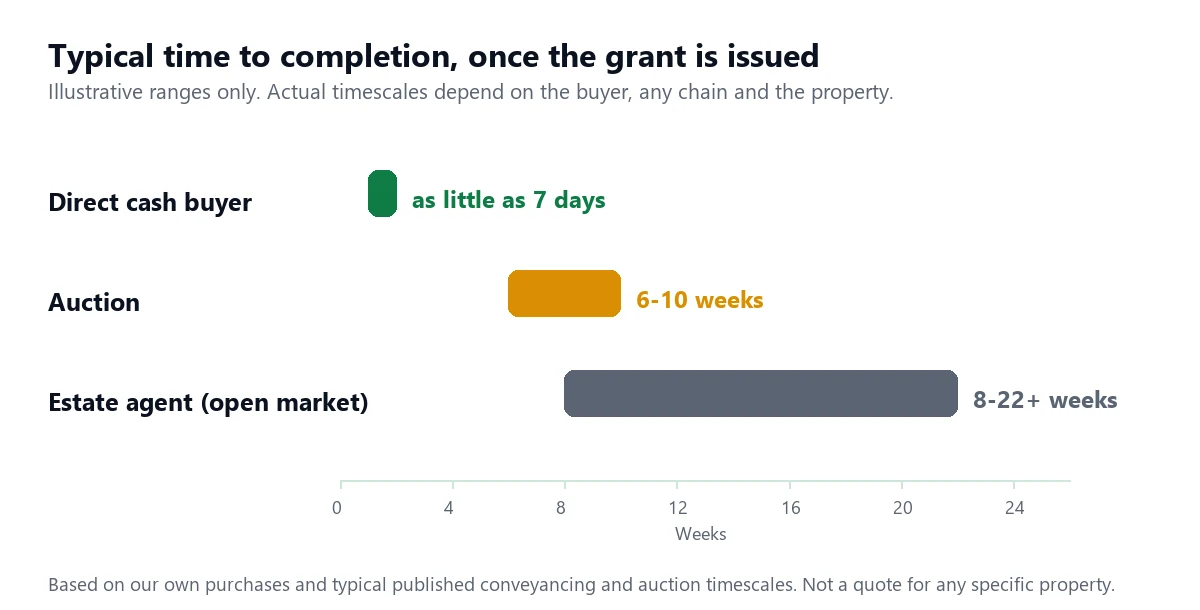
| Speed to completion | Weeks to several months, and depends on the buyer's own chain and mortgage | Can complete in as little as 7 days once the grant is issued | Fixed legal completion date, but only after the auction date itself |
| Certainty | Lower; buyers can pull out, chains can collapse | Higher; a genuine cash buyer has no mortgage or chain to fall through | High once the hammer falls; the buyer is contractually bound |
| Who pays the fees | Seller pays agent commission and usually their own legal fees | We pay our own legal fees and the seller's solicitor fees on our purchases | Buyer usually pays the auction fees, which can affect bids |
| Suits | A property in good condition, in a strong local market, where time is not the priority | Executors who want speed, certainty, and no work: clearance, repairs or an empty property sitting exposed | Unusual or hard-to-mortgage properties, or executors who want a fixed sale date |
A genuine cash buyer should always confirm proof of funds and should not need to sell the property on to another buyer before completing with you (a "double sale" or assignment of contract, sometimes used by quick-sale brokers rather than genuine cash buyers). If in doubt, ask directly whether the company is buying with its own funds.
Costs and tax when selling a probate property
Selling a probate property brings some costs beyond the usual conveyancing fees and estate agent commission:
- Probate fees themselves. Covered in full in our guide to how much probate costs.
- Capital Gains Tax on any increase in value between the date of death and the date of sale. Our guide to capital gains tax on inherited property explains how the taxable gain is worked out and what reliefs may apply.
- Ongoing costs while the property is unsold, including buildings insurance, council tax, utilities on standing charge, and basic maintenance, all normally paid by the estate.
- Clearance and probate valuation costs, such as house clearance, a RICS valuation, or agent valuations used as probate evidence.
If the property eventually sells for more than the value declared for probate, HMRC generally allows the actual sale price, if achieved within a reasonable time, to be used as better evidence of value. That can change the Inheritance Tax and Capital Gains Tax position, so keep records of both the probate valuation and the eventual sale price and speak to a solicitor or accountant about your specific figures.
Common problems when selling a probate property
- An empty property. Many standard home insurance policies restrict or void cover once a property has been unoccupied for a set period, commonly 30 to 60 days. Check the existing policy and consider specialist unoccupied property insurance if the house will sit empty during probate.
- Deferred maintenance. Inherited properties are often older or need updating, which can put off mortgage-dependent buyers and slow an open-market sale. This is one reason some executors prefer a cash sale or auction for a property that needs work.
- Disagreement among beneficiaries over whether, when, or to whom to sell. Get instructions in writing early, and involve a solicitor if beneficiaries cannot agree.
- A missing or unclear will, or no named executor able to act, which moves the estate onto the letters of administration route and typically a longer wait, as covered in our probate timing guide.
- Multiple properties or a property with a mortgage still outstanding, both of which add extra steps to valuing the estate and can affect how quickly a sale can proceed.
Real probate sale timelines
Published timescales for a probate sale vary because the biggest variable is the grant itself, not the sale that follows it. Our own recent probate purchases give a realistic range: a Coseley home took 28 days from start to completion, with contracts exchanged as soon as the grant came through; a Broseley bungalow took 56 days; and a Walsall property spent around three months waiting on the grant, with our offer held at the agreed price throughout. You can read these among our recent probate purchases, including ones that took longer than planned, deliberately not cherry-picked.
Our data, in one line: across the three published probate purchases above, start-to-completion has ranged from 28 days to just over three months, with the wait for the grant itself, not our own conveyancing, as the deciding factor every time.
An illustrative example. Suppose an executor instructs a cash buyer in week 1, agrees a price in week 2, and the grant arrives in week 7 (close to the Ministry of Justice average for a straightforward application). If contracts were exchanged conditionally in week 2, completion can follow within days of the grant landing, since there is no chain and no mortgage survey to wait on. The same property sold through an estate agent to a mortgaged buyer would still need the buyer's own mortgage offer, searches and any chain above them to complete, which is why an open-market sale of a probate property often runs well past the grant itself. This is an example, not a prediction for any specific estate.
Do you need a solicitor to sell a probate property?
You are not legally required to use a solicitor to apply for probate or to sell the property, and some executors handle straightforward estates themselves. In practice, most use one for at least the legal side of the sale (conveyancing), and many also use one for the probate application itself, particularly where Inheritance Tax is due, the will is unclear, or more than one executor or beneficiary is involved. A probate solicitor can also advise on the specific questions this guide cannot: whether a conditional exchange suits your estate, how a disagreement between beneficiaries should be handled, and how any tax liability is best managed. Costs for this are covered in our guide to how much probate costs.
FAQs: selling a house in probate
Can you sell a house before probate is granted?
No, not to completion. Gov.uk says you should not make financial plans or put property on the market until you have got probate, and a sale of the estate's property cannot legally complete without the grant. Some buyers, including us, will agree a price and exchange contracts conditional on the grant being issued, which fixes the price during the wait, but that is not the same as selling without probate.
Can an executor sell a house without all beneficiaries agreeing?
Once the grant of probate is issued, the named executors generally have the legal authority to sell estate property and do not need every beneficiary's individual sign-off to exchange and complete. That said, acting against the wishes of the beneficiaries can create disputes or even a legal challenge, so most executors keep beneficiaries informed and try to reach agreement before marketing the property. Speak to a solicitor about your specific will and estate.
Do I need probate to sell my deceased parent’s house?
In most cases, yes, if the property was owned solely by the person who died or as tenants in common. Gov.uk says you may not need probate if the property was owned as joint tenants with someone else, because it passes automatically to the surviving owner. If your parent owned the house alone or with a former partner as tenants in common, a grant of probate (or letters of administration if there is no will) is normally required before a sale can complete.
How do you sell a house that is in probate?
In outline: value the property for probate, apply for the grant (or letters of administration), then choose a route to sell (estate agent, cash buyer or auction), instruct a solicitor to handle the legal work, and complete once probate is confirmed and contracts are exchanged. We set out each of these steps in full further down this guide.
What happens if a house sells for more than the probate valuation?
It can happen, and it is not automatically a problem. HMRC's guidance allows the sale price achieved within a reasonable period after death to be used as better evidence of value than an earlier estimate, which can affect Inheritance Tax and Capital Gains Tax calculations. Our guide to capital gains tax on inherited property covers how the taxable gain is worked out.
Can you sell a probate house at auction?
Yes. Auction is one of the three main routes, alongside a traditional estate agent listing and a direct cash sale. It can suit an executor who wants a fixed completion date and a transparent, competitive sale, though the guide price is not guaranteed and auction fees are usually paid by the buyer, which can affect what bidders are willing to offer.
Who pays for the upkeep of a probate property while it is being sold?
The estate is normally responsible for costs like buildings insurance, utility standing charges, council tax and basic maintenance until the sale completes. Gov.uk's guidance on valuing an estate covers what counts as a liability of the estate. Many standard home insurance policies also restrict or void cover once a property has been unoccupied for a set number of days, commonly 30 to 60, so check the policy and consider unoccupied property cover if the house will sit empty.
What to remember
- You can market and even conditionally exchange on a probate property before the grant arrives, but completion needs the grant in hand.
- Whether probate is needed at all depends on how the property was owned: sole ownership and tenants in common normally need it, joint tenancy usually does not.
- Once granted, the named executor or administrator has the legal authority to sell, though most keep beneficiaries informed to avoid disputes.
- Estate agent, cash buyer and auction each trade off price, speed and certainty differently; there is no single right answer.
- Keep records of both the probate valuation and the eventual sale price, since HMRC can treat a later sale price as better evidence of value.
- Speak to a solicitor about your own estate. If you would like a cash offer on a probate or inherited property, tell us about it and we will give you an honest figure and timeline.